When Korean Students Go Abroad to Understand Korea: KARSI's Vietnam Winter Art Residency
Why the Best Way to Learn About Korean Colonial History Is in a Hanoi Art Gallery
There's something profoundly disorienting about standing in a French colonial mansion in Hanoi, surrounded by Vietnamese contemporary artists, and suddenly understanding your own Korean identity more clearly than you ever did in Seoul.
That's the core insight behind KARSI's Vietnam Winter Art Residency — a two-week intensive with Chau & Co. Gallery that turns students into practicing artists while they work through one of the most uncomfortable parallels in Asian history: Korea and Vietnam share remarkably similar colonial wounds, just inflicted by different empires.
the Vietnam VOLUNTOURISM Industrial Complex
Most Korea–Vietnam "educational programs" are thinly-veiled neo-colonial tourism dressed up as cultural engagement — the orphanage "volunteering" weeks, the wells and school paint jobs that take work from local contractors, the fake NGOs that exist mainly to generate application credentials. Korean money goes far in Vietnam, and an entire industry has been built around packaging Vietnamese poverty into resume material for Korean teenagers. Even the better-intentioned versions tend to frame it as Korea generously "sharing its success" — which quietly casts Korea as the developed mentor and Vietnam as the developing student, ignoring that Vietnam has sophisticated intellectual and artistic traditions Korea doesn't.
KARSI's approach treats Vietnam as an intellectual and artistic equal, not a development project or a photo opportunity.
The Parallel You Never Knew Existed
While Japan was colonizing Korea (1910–1945), France was doing essentially the same thing to Vietnam (1887–1954). Both nations experienced cultural erasure, forced assimilation, and the particular psychological damage of being told your own culture is inferior. Both emerged into devastating wars that split the country. Both spent the late twentieth century rebuilding identity under American influence and rapid modernization.
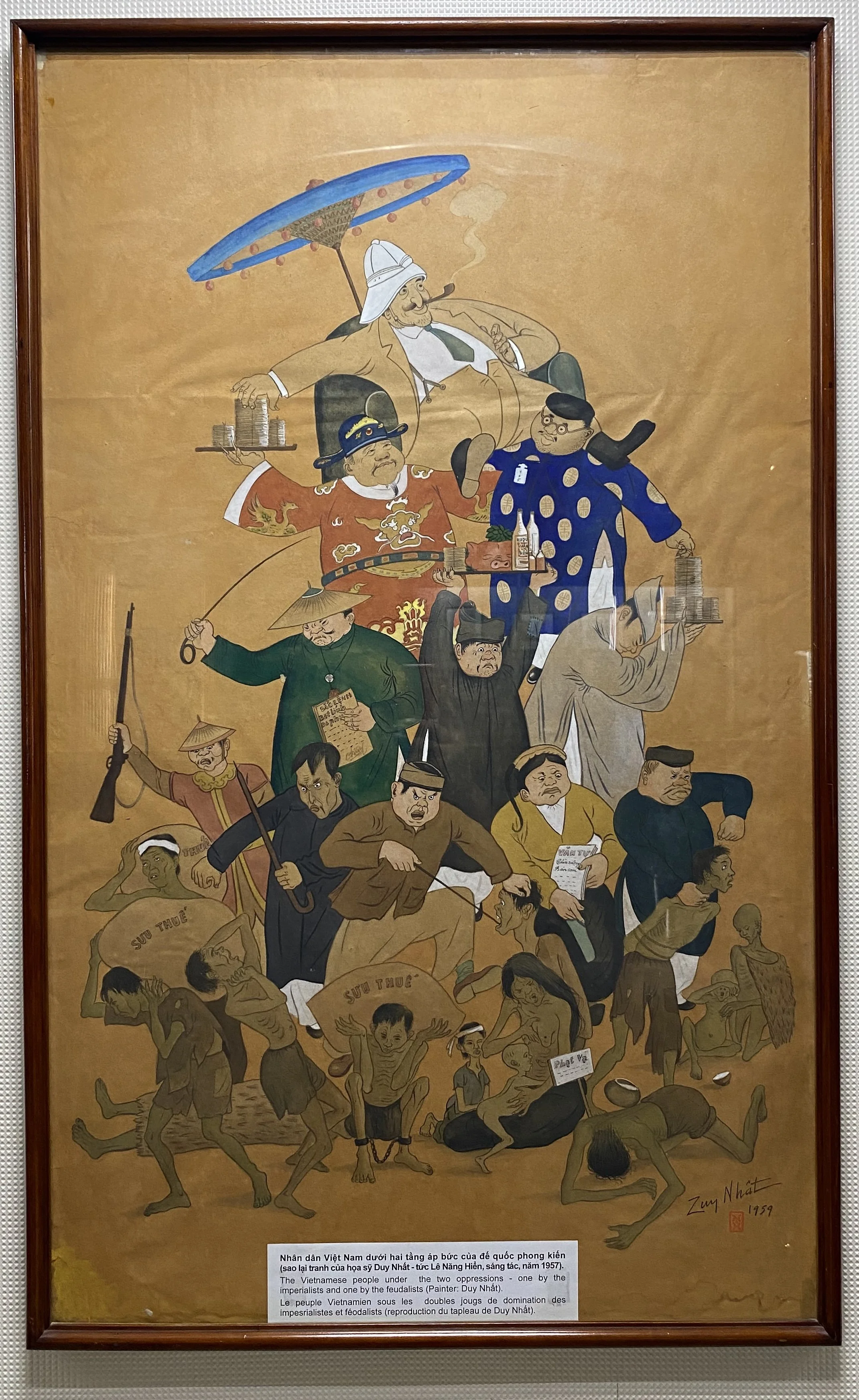
“The Vietnamese people under the two oppressions - one by the imperialists and one by the feudalists (Painter: Duy Nhắt).”
Vietnamese contemporary artists have spent decades processing this trauma through visual art — cultural hybridity, memory, identity. Korean students, by contrast, usually encounter their own colonial history through textbooks and nationalist narrative, with little room for nuance.
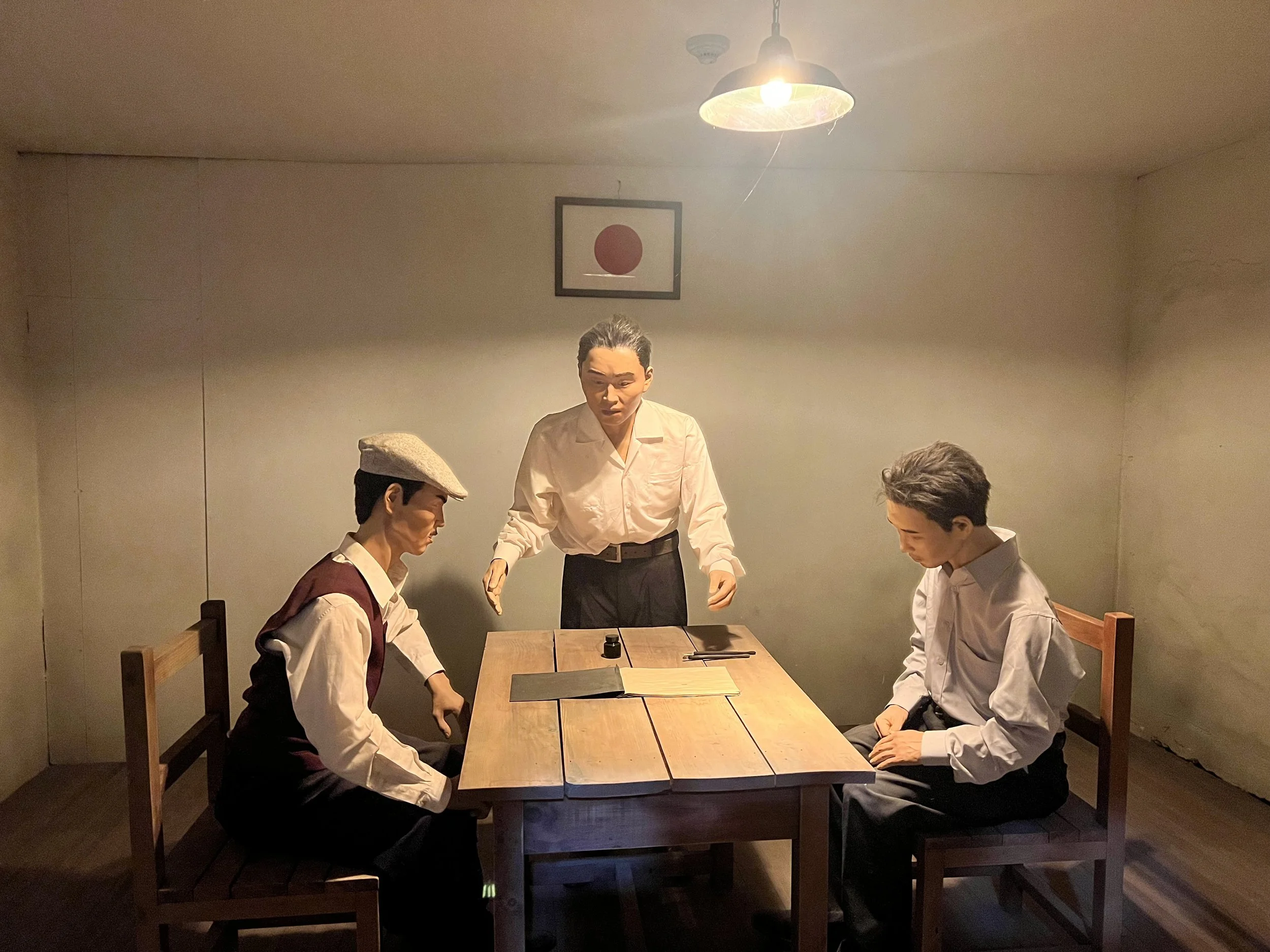
A reenactment of a colonial-era interrogation session in the Seodaemun Prison.
That parallel isn't just interesting — it's pedagogically useful. The structural similarity between Korean and Vietnamese colonial history gives students a way in: they recognize patterns in Vietnamese cultural responses because those patterns echo what their own grandparents lived through. That recognition creates the emotional aperture for real artistic inspiration, in a way two weeks in an unfamiliar context normally couldn't.
When Korean and Vietnamese Artists Ask the Same Question
Artists in both countries are grappling with an identical tension: how do you use traditional forms to make sense of modern identity?
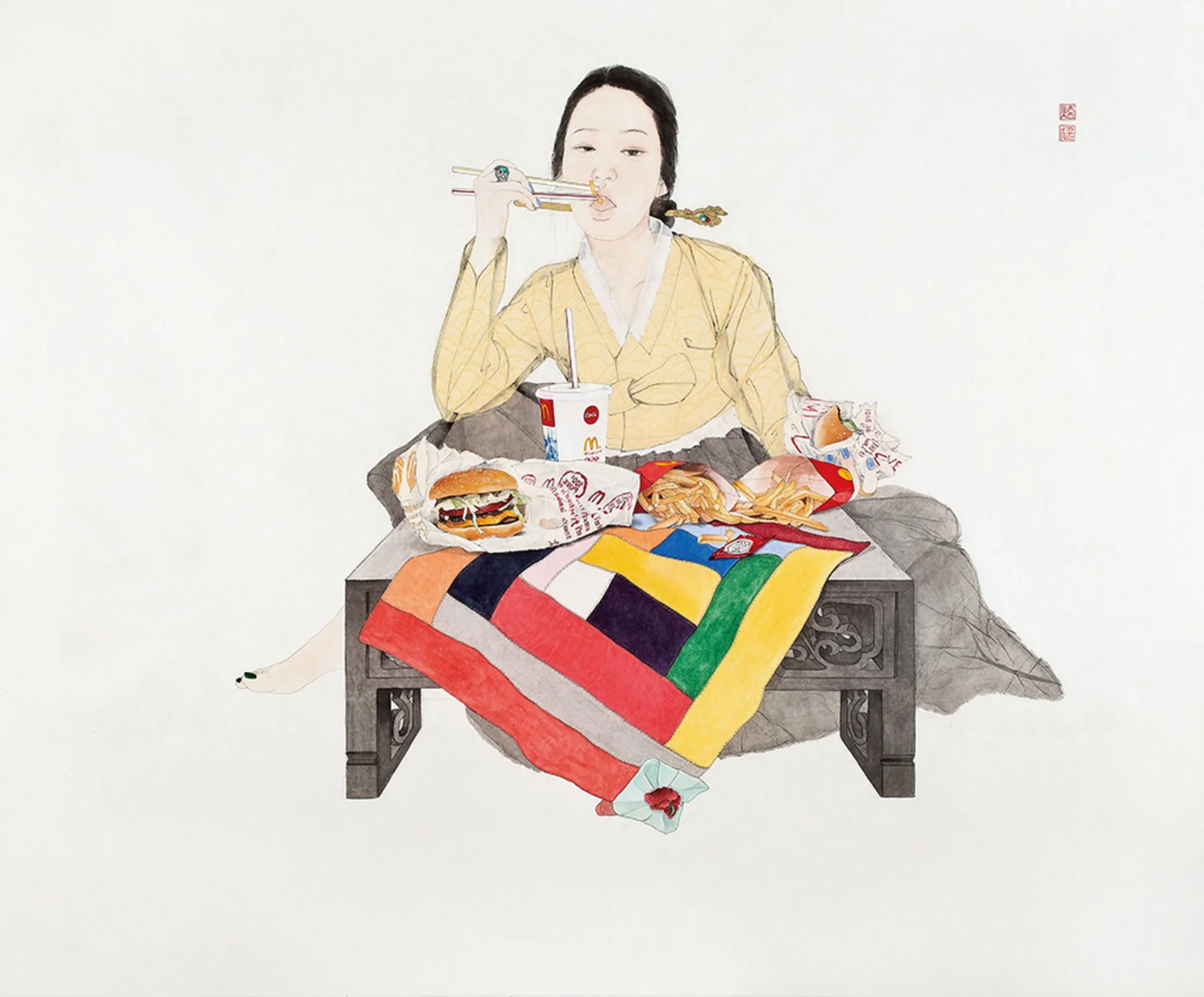
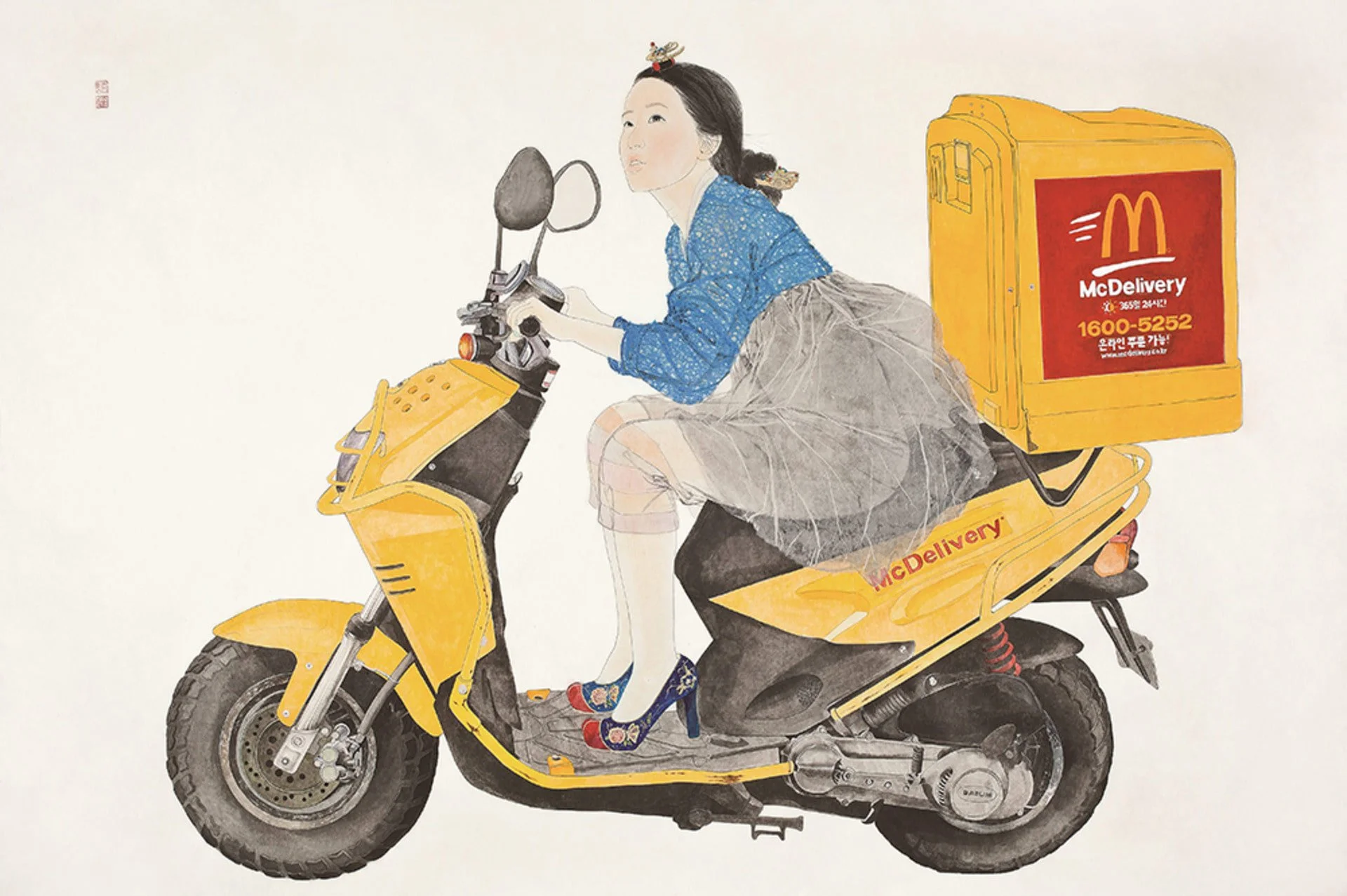
Kim Hyeonjeong paints women in hanbok eating McDonald's, playing pool, rock climbing — modern behavior rendered in traditional 동양화 technique with hanji paper collage. The hanbok goes translucent in her work, as if traditional form can't quite contain modern life.
Chiron Duong (b. 1996) made "Portraits of Ao Dai," a 365-day photography project documenting Vietnamese women in ao dai across personal memory, poetry, wartime experience, and aspiration for peace — how a single garment carries a nation's history and consciousness.
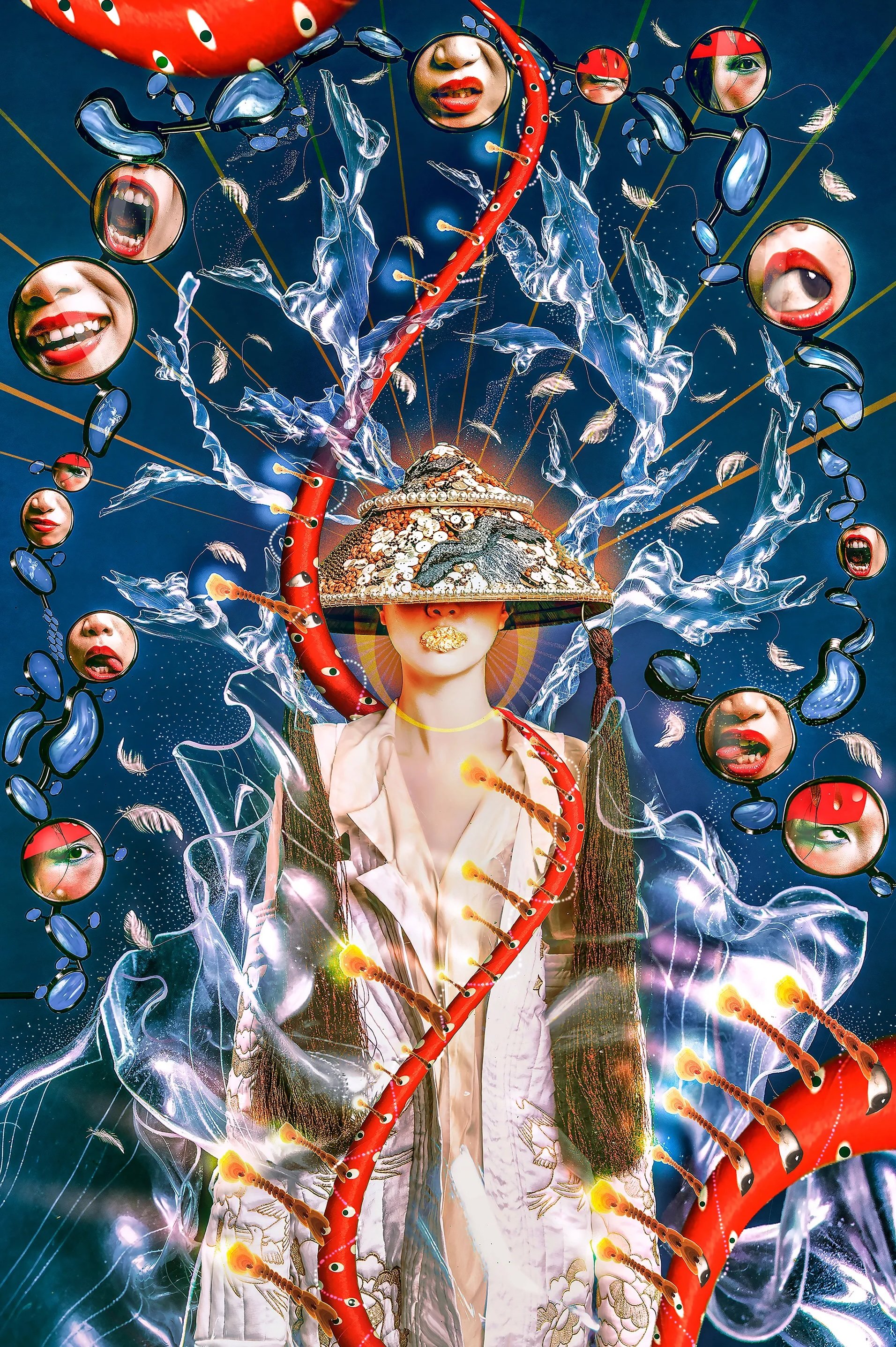
Xuân-Lam Nguyễn, a Fulbright scholar and RISD MFA candidate, calls his own approach "a combination of an archaeologist and a DJ" — excavating Vietnamese folk painting and colonial-era photographs, then remixing them into contemporary installation. His question: how do you preserve Vietnamese identity within an aesthetic framework shaped by the West?
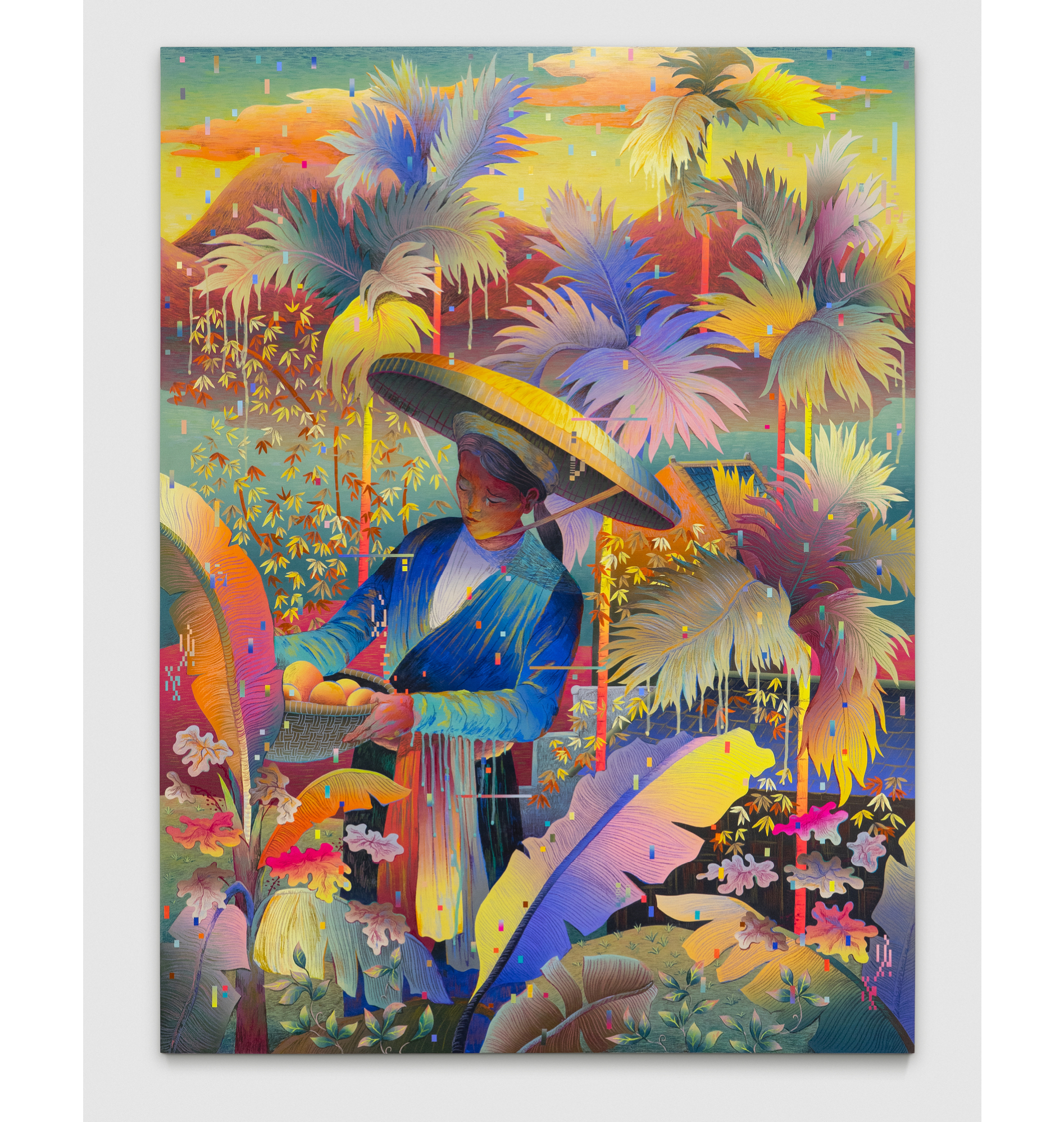
These three refuse to let tradition become a museum piece. Kim's hanbok paintings, Duong's ao dai photography, Nguyễn's folk-art remixes are all versions of the same argument playing out in different countries — which means a Korean student sees a Vietnamese artist work through the exact tension a Korean artist faces, and the formal similarity makes the cultural difference visible, and vice versa.
Why Our Partnership Model Matters
The relationship with Chau & Co. Gallery isn't a rented room. It's a genuine collaboration, and it works because of four things:
We're not extracting. Vietnamese artists aren't providing a charitable service — they're professional equals whose job is to push student work to a real standard, not to make anyone feel good about themselves.
We're not "giving back." Korean students are here to learn from Vietnamese artists doing more sophisticated work on colonial memory and hybrid identity than Korea has produced in the same domains — not to hand down anything.
We're not saving anyone. The goal is peer relationships between emerging Korean and Vietnamese artists that outlast the program, not a charity dynamic.
We pay appropriately. Vietnamese artists receive professional mentorship rates, not token honoraria. Gallery space is compensated fairly. This is a business relationship, not exploitation wearing a cultural-exchange costume.
We're in Hanoi because Vietnamese artists have the intellectual and artistic material Korean students need and can't access from inside Korea's own nationalist frameworks — not because it's cheap, though it is, or convenient, though it's that too.
Not Art Camp. Not Study Abroad Tourism. Actual Artist Residency.
This is a legitimate artist residency, adapted for advanced high schoolers ready for graduate-level cultural work — not crafts and temple photos branded as "international experience." Students work in a professional contemporary art gallery in Hanoi's emerging art district, under one-on-one mentorship from a practicing Vietnamese artist, producing installations, paintings, sculpture, or multimedia that gets exhibited in real gallery space.
That's the credential almost no high schooler has: legitimate gallery exhibition, not a school art show, not a student competition — actual collectors, critics, and artists engaging with the work. Gallery director Hoang Minh Chau, whose mission is "making art seen" and bringing foreign artists into Vietnam's contemporary scene, treats this as a genuine residency adapted for Korean students exploring cultural parallel — not a student program grafted onto her gallery for the semester.
The Pedagogical Framework: How Historical Parallels Enable Deep Creative Work
The Korea–Vietnam colonial parallel is a doorway, not a box.
It provides: emotional access — you can feel your way into understanding through empathy, not abstract study — plus a comparative case that lets you see what's universal about colonial trauma versus what's culturally specific, and raw material for authentic creative work when you recognize your grandmother's stories in a Vietnamese artist's installation.
It doesn't provide: predetermined conclusions, packaged interpretations, or instructions for what art to make.
Students consistently produce more sophisticated, more personally meaningful work in this residency than in any traditional art class — because the framework gives them enough structure to go deep in two weeks without telling them what to think.
Four Ways to Engage (Choose Your Track)
Track 1 — Cultural Ethnography & Trend Research. Fieldwork on Korean cultural influence in Vietnam — K-style cafés, fashion adoption, consumer behavior — using the same professional research methods Dr. Hurt runs for Google, Meta, and Pinterest. Anthropology plus marketing plus visual analysis.
Track 2 — Documentary Photography. Street, portrait, and environmental photography, studying Cartier-Bresson, Lange, Fan Ho, and Salgado while building an original photo essay on contemporary Vietnamese life.
Track 3 — Comparative Colonial Histories Through Art. The most academically rigorous track: archival research into parallel colonial experiences, then installations comparing how both cultures process trauma, with graduate-level mentorship and a path toward academic publication.
Track 4 — Contemporary Vietnamese Identity. Direct collaboration with emerging Vietnamese artists on installation and multimedia work about modern cultural identity — less colonial history, more present-day cultural production.
What Two Weeks Actually Looks Like
Week 1 — Orientation, Then Fieldwork
Days 1–2 aren't fieldwork yet — they're orientation. Cultural-history lectures, guided tours of the city, a structured overview of the colonial parallel: mostly passive, an information download meant to give students something to stand on before they're on their own. Evenings are where the real work starts without anyone directing it — first dinners, first encounters on the street, a Situationist dérive or two (deliberate, unplanned wandering through the city) — enough for each student to arrive at their own emotional foothold in the place before anyone tells them what to think about it.
Days 3–7 shift into focused work: mentor matching, then fieldwork — museums, archives, artist studios, interviews, neighborhood photography, gallery events.
Week 2 — The Same Focus, Toward Exhibition
The mentor-and-fieldwork rhythm from Day 3 carries straight through. Days 8–12: full-time studio work with mentor guidance and daily critique. Days 13–14: exhibition prep, final presentation to Hanoi's art community, portfolio compilation.
A Note on the Dérive
The dérive (French: "drift") comes from Guy Debord and the Situationists — deliberately unplanned wandering through a city, letting the streets pull you rather than following an itinerary. It isn't free time. It's a method: a place reveals itself differently once you stop moving toward a destination and start moving toward whatever catches you. Students who've spent their lives inside structured itineraries — school trips, family vacations, the volunteer-tourism circuit — often find that an evening with nowhere to be and nothing to accomplish is the first time they've actually encountered a foreign city on its own terms, instead of the terms of whoever built the program. That unscripted encounter is where the real, personal material for creative work comes from — not from a lecture about it.
None of this is unsupervised risk. Hanoi's Old Quarter is dense and thoroughly mapped — Google Maps is as reliable in Vietnam as it is in Seoul, and every student carries a local SIM. In city blocks this tight, "drifting" still means staying within a few hundred meters of a known landmark, not disappearing into unfamiliar territory. Nobody is ever more than a phone call away from a mentor or the program team. Unplanned isn't unsupervised — those are two different things.
Students stay in guesthouses or vetted homestays, not tourist-zone hotels — living in the neighborhood is the point. This is immersive to the point of discomfort, which is also the point.
Why This Matters for Your Future
College applications: admissions officers see plenty of "volunteered at an orphanage." They almost never see a high schooler with legitimate gallery exhibition credentials, mentorship from a practicing artist, and research that contributes to an actual scholarly conversation — a professional-level credential most people don't touch until graduate school.
Understanding Korean identity: you can't see your own culture clearly from inside it. Vietnam is similar enough to recognize the pattern and different enough to see what's specifically Korean rather than generically Asian — an emotional register textbooks don't reach.
International networks: relationships with Vietnamese artists building careers in Asia's contemporary art market continue past the program, through exhibitions and collaboration.
The Practical Details
When: January 2027 (2 weeks intensive)
Where: Chau & Co. Gallery, Hanoi, Vietnam
Group Size: 5-10 students (small cohorts for intensive mentorship)
Cost: $6,100-7,200 all-inclusive (program fees, accommodation, mentorship, materials, gallery access)
Prerequisites: None — program designed to develop students from basic interest to professional capability
Who Should Apply
This works for students who: want to make meaningful art, not pad a résumé; can sit with ambiguity and cultural discomfort; are genuinely curious how colonialism shapes contemporary culture; prefer depth over breadth; are ready to accept that Vietnamese mentors will push their work hard.
This doesn't work for students who: need constant supervision and handholding; want an easy international credential; are looking to "help" Vietnam or feel good about charity; expect deference because they're paying.
Ready to Create Something That Matters?
The next Vietnam Winter Art Residency runs Winter 2027. Applications open late 2026.
For students who've outgrown surface-level international experience: a chance to develop as an artist, understand Korean identity through Vietnam's parallel story, and earn gallery exhibition credentials almost no other applicant has — but only if you're ready to engage with Vietnam as an equal, not a backdrop for your own development.
Contact KARSI for application details and program information.
The Vietnam Winter Art Residency is a collaboration between KARSI (Korean Advanced Research & Studies Institute) and Chau & Co. Gallery, combining Dr. Michael Hurt's expertise in Korean–Vietnamese cultural flows with Hoang Minh Chau's commitment to emerging artist development and international cultural exchange.
AI Usage Acknowledgment
This article was developed through collaboration between Dr. Michael Hurt and Claude (Anthropic). AI assistance was used for research synthesis, structural organization, and drafting. All substantive content, pedagogical frameworks, program details, and critical arguments reflect Dr. Hurt's expertise in Korean-Vietnamese cultural flows, visual sociology methodology, and educational program design developed over 17+ years of research and practice. Background research on contemporary Vietnamese and Korean artists was conducted using web search tools, with all factual claims verified against primary sources. Final editorial decisions, program philosophy, and strategic positioning remain under human direction.