KOREA IS GOOD TO THINK
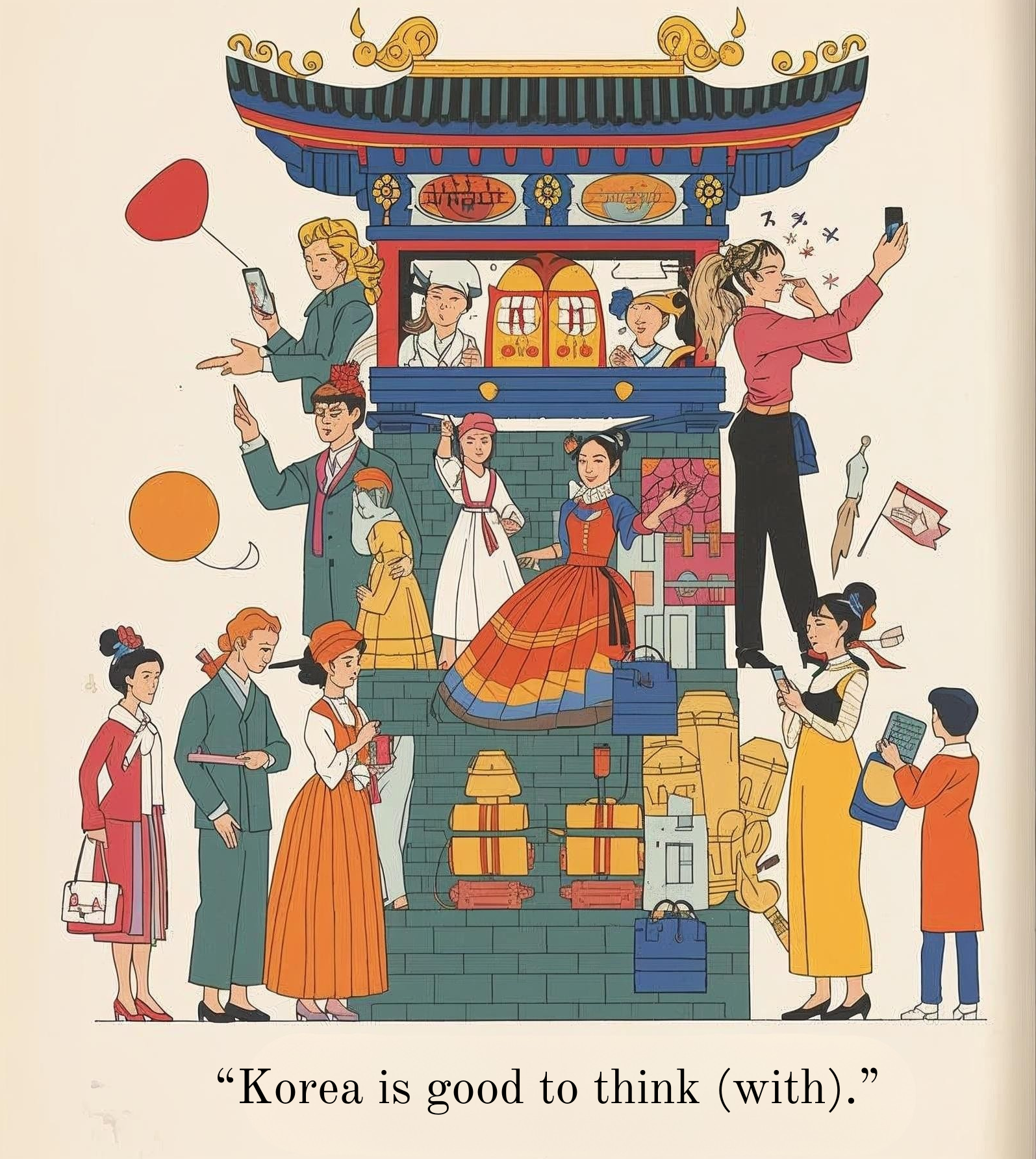
A KARSI Manifesto
In 1962, the anthropologist Claude Lévi-Strauss made an observation that would transform how we think about thinking itself. Studying totem poles among indigenous peoples of the Pacific Northwest, he noticed something peculiar: these communities didn't choose animals for their totems because the animals were useful or important. They chose them because animals were, in his famous phrase, "bon à penser" - good to think with.
Not good to think about. Good to think with.
Here's what he meant.
Imagine you're part of a Pacific Northwest indigenous community trying to organize a complex social system. You need to explain who can marry whom. Which families have authority over which resources. How different clans relate to each other. Who owes obligations to whom. These are abstract, complicated social relationships.
Now imagine your totem pole. At the top: an eagle. Middle: a bear. Bottom: a raven. These aren't random decorations. They're a thinking tool.
The eagle represents your clan. The bear represents the clan across the river. The raven represents the coastal clan. Now, instead of saying "Members of our social group cannot marry each other but must marry outside the group, and the resulting children belong to the mother's line," you can say: "Eagles don't marry eagles. When an eagle marries a bear, the children are bears."
Suddenly, abstract kinship rules become concrete and memorable. The animals aren't symbols pointing to something else. They're a system for thinking through social complexity. The totem pole is cognitive infrastructure.
But here's what makes them "good to think" - the animals bring their own properties into the system. Eagles soar high, hunt alone, have keen vision. Bears are powerful, territorial, hibernating. Ravens are clever, social, opportunistic. These natural characteristics become available for thinking about social relations.
"Why do the Eagle people get to decide about mountain hunting?" "Because eagles see everything from above."
"Why are Bear people so territorial about their fishing spots?" "Bears defend their territory."
The natural world provides a ready-made structure that you can map onto social organization. This mapping isn't arbitrary - it creates a coherent system where social rules feel natural, memorable, logical. The totem pole isn't describing social reality. It's providing a framework for organizing it.
This was Lévi-Strauss's insight: some things in the world function as more than objects of study. They become instruments of thought themselves. They don't just contain information - they transform how we process information. They're not just interesting - they make us see differently. They provide structure for understanding something else entirely.
The totem pole makes kinship rules graspable. The animal classification system makes social hierarchy coherent. It's brilliant cognitive technology.
But here's the key question: what are we trying to understand? What are our "kinship rules" - the abstract, complex systems we need to make visible and graspable?
We're trying to understand hypermodernity. Late capitalism. Digital transformation. The reorganization of human life around consumption, acceleration, and screens. The collapse of old social structures and the emergence of new ones. The future that's arriving faster than we can process it.
These processes are hard to see clearly because:
They happen too slowly in most places (like watching a plant grow in real time)
They're normalized (like fish not noticing water)
They're embedded in our daily lives (too close to observe)
They're abstract (no physical form to point at)
We need what those Pacific Northwest communities had: something concrete that makes the abstract visible. Something that brings properties into focus that help us understand patterns we couldn't see otherwise.
This is where Korea functions like the totem pole.
K-pop as Hypermodern Thinking Tool

K-Pop can focus theory.
Take K-pop. You can't understand what it is using modern categories. It's too hybrid. Too constructed. Too obviously manufactured. There's no singular "authentic" source. It samples American R&B, Japanese idol culture, European EDM, hip-hop, everything. According to modern ideas about authenticity and cultural production, this should collapse into meaningless pastiche.
Instead, it becomes the most successful, truly global pop musical art form of the 21st century.
Watch what happens when Americans try to analyze K-pop using modern frameworks. The critique: "K-pop is just cultural appropriation." Korean artists wearing cornrows, using Black American musical styles, performing hip-hop - without proper attribution to the "authentic" source. This critique reveals everything about American thinking and nothing about K-pop.
But here's what's crucial: K-pop doesn't actually claim ownership over these elements. It's not pretending to have invented hip-hop or R&B. It's not erasing the sources. It's just radically unconcerned with footnoting everything. And this distinction reveals the entire modern/hypermodern divide.
Cultural appropriation, as Americans define it, requires:
Taking from a marginalized culture
Claiming it as your own / erasing the origin
Profiting while originators don't
Refusing to acknowledge the source
K-pop does something different. It samples, borrows, remixes - but it never claims invention. When BTS uses hip-hop beats, they're not saying "we invented this." When BLACKPINK references 90s R&B, they're not claiming to be the originators. They're just... using these elements. Mixing them. The lack of formal citation isn't erasure - it's operating in a framework where the citation anxiety itself doesn't exist.
K-pop is not ELVIS.
This reveals something crucial about Western modernity: the obsession with proper attribution is itself a specifically Western modern anxiety. It comes from:
Academic citation culture (footnote everything or it's plagiarism)
Intellectual property law (everything must have an owner)
Individualist ideology (credit the individual creator)
Protestant guilt culture (you must acknowledge your debts)
These aren't universal human values. They're modern Western values, and relatively recent ones, at that. Before modern IP law, before academic citation practices, culture worked differently. Folk music didn't footnote influences. Oral traditions didn't cite sources. Artisans learned techniques and used them without writing acknowledgment essays. Culture was understood as inherently shared, inherently collective, inherently remixable.
K-pop's approach is actually closer to how culture traditionally worked - and how it works in hypermodernity. Culture as commons, not property. Influence as flow, not debt. Creation as mixing, not invention from nothing. The demand that K-pop "properly credit" every influence reveals Western anxiety about cultural ownership, not a universal ethics.
The "cultural appropriation" lens is a specifically American tool, developed to address specifically American problems - the country's particular racial history, its ongoing struggles with theft of Black cultural production, its need to police boundaries around ownership and authenticity. It's a modern framework that assumes:
Culture has clear origins and owners
Authenticity comes from proximity to source
Borrowing requires permission from originators
Hybridity is suspect without a proper genealogy
Citation equals respect; lack of citation equals theft
Apply this American lens to K-pop and you get incoherence. Who owns hip-hop beats when they're sampled in Tokyo, remixed in Seoul, and consumed in Jakarta? Where's the "authentic" when NewJeans uses Jersey Club (itself a hybrid of Baltimore Club and New York house music) filtered through Korean production? What does "appropriation" even mean when Korean teenagers learn choreography from YouTube, Black American dancers learn K-pop moves from TikTok, and Indonesian fans create their own fusion versions of all of the above?
The problem isn't K-pop. The problem is trying to analyze hypermodern cultural circulation using modern American categories.
Because K-pop operates on hypermodern logic. In modernity, authenticity required an origin point. "Real" blues came from the Mississippi Delta. You could trace cultural forms back to their source. In hypermodernity, the "original" is constantly shifting. K-pop doesn't pretend to have an origin point. It openly performs its hybridity. The sampling, the borrowing, the recombination - this isn't hidden. It's the aesthetic. It's the point.
K-pop makes visible how culture actually works in the digital age:
Cultural transmission is multidirectional sampling, not linear origin-to-copy
Hybridity isn't weakness but the condition for new forms
Authenticity is performed through commitment to construction, not by hiding it
The global and local are inseparable
"Appropriation" assumes stable ownership that doesn't exist in hypermodernity
When you grasp how K-pop works, you suddenly understand TikTok trends, Instagram aesthetics, remix culture, influencer authenticity, digital identity performance. K-pop is the concrete example that makes hypermodern cultural production graspable. Just as the eagle on the totem pole helped explain social hierarchy, K-pop helps explain how culture spreads in the digital age.
And here's the key: once you understand K-pop's logic, you realize the "cultural appropriation" critique tells you more about American parochialism than Korean culture. Americans project their domestic racial politics onto a global phenomenon, then wonder why the analysis doesn't work. The tool is wrong for the object. You can't use modern frameworks to understand hypermodern culture.
Korea's Other Properties That Clarify
And K-pop isn't alone. Korea has other structural properties that function the same way:
Time compression - 70 years of modernization instead of 200 works like time-lapse photography, making structure visible that's normally invisible
Scale and intensity - everything turned up to maximum works like a microscope, making patterns that exist everywhere become observable
The convenience store - 24/7 stores every 50 meters carrying 3,000 SKUs where people eat meals instead of cooking, revealing consumption-as-infrastructure rather than consumer choice
The birth rate collapse - 0.72 fertility rate showing the endpoint of what every developed economy is experiencing more slowly
The online gender wars - extreme polarization revealing what happens when gender politics fully digitizes
The idol training system - human development as product engineering, making visible how identity becomes commodity under late capitalism
Each of these works like the eagle or raven on the totem pole. They're concrete things you can point to that suddenly make abstract global processes graspable. Korea isn't interesting because it's exotic or unique. Korea is "good to think with" because it clarifies patterns that exist everywhere.
Just as you could point to the eagle on the totem pole and suddenly kinship rules made sense, you can point to K-pop or Korean convenience stores or the birth rate and suddenly hypermodernity makes sense.
Korea is our totem pole. Not because Korea represents hypermodernity, but because Korea provides the conceptual structure for understanding it. Korea makes the abstract concrete. Korea makes the invisible visible. Korea gives us something to point at when we're trying to explain forces that are otherwise too diffuse, too normalized, too slow-moving to grasp.
Seventy years after Lévi-Strauss found totem poles good to think with, we've found ours.
It's called Korea.
HOW KOREA CLARIFIES: FOUR REVELATIONS
Now that we understand Korea as our conceptual tool for grasping hypermodernity, let's examine precisely how it works. Korea clarifies global patterns in four specific ways, each functioning like a different property of the totem pole - making visible what would otherwise remain abstract and ungraspable.
The people who really know - the executives at global firms tracking consumer trends, the tech companies monitoring digital behavior, the fashion brands watching street style - they understand this. They're not studying Korea because it's exotic. They're studying Korea because it's predictive. Korea is the early warning system. Korea is the preview.
This isn't mystical. It's structural. And it operates through four mechanisms:
First: Korea shows us modernity at maximum intensity - and reveals the transition to hypermodernity itself.
Second: Korea makes social structures visible through material culture. In a world that pretends individual choice is real, Korea shows you the collective patterns.
Third: Korea arrived at the digital future first. Everyone's heading there; Korea can tell you what it's like.
Fourth: Korea doesn't have unique problems - it has our problems, clarified. Every "Korean crisis" is a global crisis that Korea reached first.
Let's examine each in detail.
MODERNITY AT MAXIMUM INTENSITY

Korea is hypermodernity set to 11.
Consider the birth rate collapse.
South Korea's fertility rate in 2023: 0.72 births per woman. Lowest in the world. Lowest in recorded human history. The headlines write themselves: "What's Wrong With Korea?" "Korea's Demographic Crisis" "Why Korean Women Are Refusing to Have Children."
Wrong question.
Look at the global pattern. Italy: 1.24. Spain: 1.19. Japan: 1.26. Singapore: 1.05. Every developed economy trending in the same direction. The question isn't "What's wrong with Korea?" The question is: "What does Korea reveal about where everyone's heading?"
Korea didn't invent this problem. Korea has the same forces as everywhere else:
Housing costs that make family formation impossible
Work cultures that demand total devotion
Women choosing careers over unpaid domestic labor
Rising costs of child-rearing under late capitalism
Education systems that require massive parental investment
The difference? Korea compressed all these forces into a shorter timeframe and higher intensity. You can see the endpoint clearly. While other countries are at 1.5 or 1.3, wondering if there's a problem, Korea is at 0.72 saying: "Yes. There's a problem. This is where you're all going. This is what the endpoint looks like."
Or consider the online gender wars.
Korea: the 4B movement (women refusing dating, sex, marriage, childbirth with men). Extreme polarization. Radical feminism versus incel culture. Digital warfare between genders. International headlines: "Korea's Unique Gender Problem."
Wrong again.
The United States: manosphere, Andrew Tate, tradwife content, abortion politics, men's rights activism. Same fault lines. Same digital amplification. Same radicalization patterns. The UK, Australia, China - the same tensions everywhere. Korea just got there first, made it louder, made it visible.
What Korea reveals: when you digitize gender politics, accelerate social change, and make everyone audible online, you get intense polarization. The digital transformation doesn't resolve old tensions - it amplifies them. Korea is showing us the future of gender relations in hypermodernity. Not because Korea is unique, but because Korea removed the polite fictions first.
This is the pattern. Korea experiences global processes faster and more intensely. That intensity makes structure visible.
AND BEYOND: THE HYPERMODERN THRESHOLD
But here's where we need to be precise about what Korea actually shows us.
Korea doesn't just show us "modernity at maximum intensity" - though it does that. Korea shows us something more radical: the transition from modernity to hypermodernity, and what life looks like on the other side.
Modernity - the project of industrialization, urbanization, rationalization, progress - took 200 years in the West. Korea compressed it into 70 years. But something happened in that compression. Korea didn't just speed up modernity. Korea transformed it into something qualitatively different.
This is what theorists like Gilles Lipovetsky call hypermodernity - not post-modernity (which declared modernity dead), but modernity radicalized, intensified to the point where it becomes something else entirely.
Characteristics of Hypermodernity
Acceleration becomes the environment - not just fast, but acceleration itself is the permanent condition
Consumption becomes identity - not "I buy things" but "I am what I consume"
Technology becomes infrastructure for existence - not tools we use but the medium we inhabit
The present devours past and future - constant nowness, perpetual immediacy
Individualism becomes mandatory - you must construct yourself through choices
Excess becomes normal - more options, more stimulation, more everything
Korea gives us a live preview of what happens when a society crosses this threshold.
The Korean Convenience Store
Modernity: Stores open during business hours, carry what people need.
Hypermodernity: 24/7 convenience stores every 50 meters in Seoul, carrying 3,000+ SKUs, constantly refreshed, some items available literally nowhere else, where young people eat meals because cooking implies a stable domestic life they don't have.
This isn't just "more convenient." It's a different relationship to consumption, time, and domestic life. The convenience store isn't serving modern needs efficiently - it's infrastructure for hypermodern existence where acceleration, individualism, and consumption have merged into a new way of being.
The Idol Training System
Modernity: Talent development through apprenticeship.
Hypermodernity: Children entering multi-year training contracts, learning to perform perfect synchronized humanity, emerging as products engineered for digital consumption, where authenticity is constructed through visible labor.
This isn't entertainment industry intensified. This is human development reimagined as product development - the logical endpoint when consumption becomes identity and identity becomes commodity.
K-pop as the Ultimate Hypermodern Art Form
And this brings us to K-pop itself - not as Korean cultural export, but as the purest expression of hypermodernity in artistic form.
K-pop shouldn't work according to modern aesthetic theory. It's too hybrid. Too constructed. Too obviously manufactured. There's no singular "authentic" source to trace back to. It samples from everywhere: American R&B, Japanese idol culture, European electronic music, hip-hop, rock, EDM. The choreography borrows from vogueing, from Michael Jackson, from street dance, from musical theater. The visuals reference everything from haute couture to streetwear to anime.
According to modern ideas about authenticity and cultural production, this should collapse into incoherence or pastiche. Instead, it becomes the most successful pop cultural form of the 21st century.
Why?
Because K-pop operates on hypermodern logic where the concept of "original" has fundamentally shifted.
In modernity, authenticity required an origin point. "Real" blues came from the Mississippi Delta. "Real" hip-hop came from the Bronx. You could trace cultural forms back to their source, and authenticity meant proximity to that source.
Hypermodernity doesn't work this way. In hypermodernity, the "original" is constantly shifting. K-pop doesn't pretend to have an origin point. It openly performs its hybridity. The sampling, the borrowing, the recombination - this isn't hidden. It's the aesthetic.
Again, NewJeans is the perfect example. Their sound: Y2K American R&B mixed with Jersey Club beats. Their styling: 90s American teen fashion filtered through Korean curation. Their choreography: references to 2000s American music videos. Nothing about NewJeans is "originally Korean" in the traditional sense.
Yet NewJeans feels completely coherent. Why? Because they're not trying to be "authentic" in the modern sense. They're authentic to hypermodernity itself - where cultural production means sampling, remixing, curating, and presenting with absolute commitment to the performance.
This is what makes K-pop "good to think." It reveals how culture actually works in the digital age:
Cultural transmission is no longer linear - not from origin to copy, but multidirectional sampling
Hybridity is not weakness - it's the condition of possibility for new forms
The "authentic" is performed, not inherited - realness comes from commitment to the construction, not from hiding it
The global is the local - trying to separate them is the category error
"Appropriation" assumes stable ownership that doesn't exist in hypermodernity
Citation anxiety is a modern Western obsession, not a universal ethic
When thinking about “Korea” in terms of a set of western concerns, things get dodgy fast. One useful thing to consider when approahing “Korea” in a critical context is why one is doing it. Is it to use Korea as a test case for outside rubrics? Or are we looking at Korean things and making out the patterns and conclusions from the Korean circumstances?
The problem isn't K-pop. The problem is analyzing hypermodern phenomena with modern American categories. It's like trying to understand quantum mechanics with Newtonian physics - the math doesn't work because you're in a different paradigm.
K-pop idols training for years to perfect spontaneity. Manufactured groups creating genuine emotional connection. Highly controlled systems producing individual expression. These aren't contradictions - they're how hypermodernity works. The labor is visible. The construction is obvious. And this doesn't diminish authenticity - it redefines it.
Western observers often critique K-pop as "fake" or "too manufactured" - revealing they're still thinking in modern terms. Real versus fake. Authentic versus constructed. Original versus copy. These binaries don't apply in hypermodernity. K-pop transcends them not by hiding the construction, but by making the construction itself the art form.
This is why global pop music increasingly looks like K-pop - not because everyone's copying Korean style, but because K-pop figured out the aesthetics of hypermodernity first. The precision choreography, the visual storytelling, the multi-platform content strategy, the parasocial intensity - these aren't Korean innovations. They're hypermodern innovations that became visible in Korea first.
What Korea Reveals About Hypermodernity
1. There's no going back
Once you cross into hypermodernity, you can't return to modernity. Korea can't "slow down" or "find balance." Hypermodernity is a stable state, not a transition phase.
2. It's not dystopia - it's just different
Western observers call Korea's hypermodernity "extreme" or "unhealthy." But Korea isn't suffering from hypermodernity - Korea is hypermodernity. It works. People function. Society operates. It's just structurally different from modernity.
3. Everyone's heading there
Modernity was a phase. Hypermodernity is the destination. Korea arrived first. You can see what the endpoint looks like. The acceleration, the consumption-as-identity, the digital-physical collapse - these aren't Korean choices. They're what happens when modernity keeps going.
4. It requires new conceptual tools
You can't understand hypermodernity with modernity's frameworks. Western social science still thinks in modern terms: work-life balance, authentic self, rational choice, stable identity. These concepts don't work in hypermodernity. Korea forces you to develop new ones.
This is why Korea is especially good to think. Not just because it clarifies modernity, but because it shows us what comes after. Korea is living in our future, and it can tell us what it's like there.
When executives at global firms say they're watching Korea, they're not watching Korean culture. They're watching how humans adapt to hypermodernity. Because adaptation is required. You can't opt out. The acceleration is coming everywhere.
Korea just stopped pretending you could slow it down.
MAKING SOCIAL STRUCTURES VISIBLE

From seeming abstraction and chaos, order.
Saturday night in Hongdae, Seoul's youth culture epicenter. Thousands of young people flood the streets around the clubs and cafés. At first glance: radical individuality. Everyone expressing their unique personal style. Look closer: everyone looks "unique" in exactly the same way.
Oversized fits in specific proportions. Particular color palettes. Certain silhouettes. Each person thinks they're making individual choices. The crowd reveals the structure. This is what the sociologist Émile Durkheim called "social facts" - external constraints that feel like individual choices. Fashion is the clearest example. You "choose" what to wear, but really, you don't.
Here's why Hongdae matters for understanding global culture.
In the 1990s and 2000s, the West obsessed over Harajuku street fashion in Tokyo. Magazines sent photographers. Documentaries celebrated the creativity. But it was easy to dismiss. "Japan is so weird!" "Japanese youth are so creative and different!" The Orientalist fascination made it exotic, which made it ignorable. Whatever was happening in Harajuku could stay in Harajuku. It was culturally specific, bounded, contained.
Hongdae is different. Hongdae isn't "Korean weird." It's global fashion at maximum intensity.
The same brands circulating globally. The same silhouettes spreading through Instagram and TikTok. The same aesthetics moving from Seoul to London to New York to Melbourne. Korea isn't producing exotic local fashion. Korea is participating in global fashion - just faster, clearer, more completely.
Walk through Hongdae, and you see exactly how global fashion actually spreads:
High material culture density (everyone participates, no one's "above" fashion)
Rapid turnover (trends emerge and die fast enough to see the cycle)
Complete adoption (when something hits, it really hits)
Digital documentation (every outfit photographed, creating feedback loops)
This isn't "Korean fashion." It's global fashion with the volume turned up until you can actually see how it works.
Consider the wrinkle socks phenomenon from Fall 2024. Suddenly, hundreds of young women in Seoul wearing socks in a specific, bunched, wrinkled way. Not sold in stores yet - just appearing. Not coordinated - just emerging. Each girl "independently" discovering the same aesthetic at the same time.
This is how fashion actually spreads in the digital age. Not through marketing or retail. Through embodied knowledge, visual transmission, peer influence operating below conscious awareness. Korean fashion makes this mechanism visible because Korea's digital culture density is high enough to see the pattern.
Global fashion brands don't just sell in Korea. They watch Korea. Fast fashion companies test in Korea. Trend forecasters study Korean streets. Because Korea is the early warning system. The patterns visible in Korea show up everywhere else six months later.
But the insight goes deeper. Korea isn't just ahead on trends. Korea reveals something fundamental about how social structures work in hypermodernity. In the West, we pretend our choices are individual. We say we have "personal style." We claim to be "expressing ourselves." Korea doesn't bother with this fiction. The collective nature of "individual" choice is the whole point. Social structures aren't hidden behind personal authenticity rhetoric - they're performed, celebrated, made visible.
What you learn from studying Korean fashion isn't "what Koreans like." You learn how collective behavior gets experienced as individual choice. That's not a Korean thing. That's a human thing. Korea just lets you see it.
ARRIVING AT THE DIGITAL FUTURE FIRST
In 1994, most Koreans didn't know what the Internet was. In 1999, Korean teenagers were dominating global Starcraft tournaments on the fastest broadband connections on Earth. This wasn't gradual adoption. It was phase change.
Everyone thinks they understand digital culture. Korea shows us what it actually means.
Consider the Instagram café phenomenon. Seoul has thousands of cafés that exist primarily to be photographed. Not "cafés with Instagram-worthy design" - cafés whose entire purpose is the photograph. The coffee is secondary. The space is a photography set. Twenty-dollar lattes served in elaborate presentations that last about ninety seconds before being documented and abandoned.
"That's just Korea being weird about aesthetics."
No. London has the same pattern. New York has the same pattern. Melbourne has the same pattern. Every major city has Instagram-bait venues. Korea just stopped pretending the experience is primary. The experience isn't primary anymore. The documentation of the experience is primary. Korea got honest about it first.
In Korea, every music festival is content creation. Every restaurant meal is a potential Instagram story. Every vacation is Story material. Korea just removed the cognitive dissonance. In the West, we still pretend we're "living in the moment" while filming everything. Korea dropped the pretense.
What Korea reveals: digital life isn't "enhanced" analog life. It's a different ontology. Authenticity isn't lost - it was never the point. Identity construction through digital performance is the game we're all playing. Korea just plays it consciously.
The global firms understand this. Gaming companies watch Korea because PC bang culture predicted esports. Social media platforms watch Korea because Stories, live streaming, and virtual goods monetization all emerged clearly there first. E-commerce companies watch Korea because mobile-first, social commerce, and instant gratification logistics were perfected there.
Korea is the testing ground because Korea lives in the digital future. Whatever Korea does with digital culture, you'll be doing in five years.
OUR PROBLEMS, CLARIFIED
The pattern repeats across every "Korean crisis" that makes headlines.
Work culture: Korea has mandatory company dinners (회식), death from overwork, no work-life boundaries. Headlines: "Korea's toxic work culture." But the U.S. has hustle culture, midnight emails, no boundaries. Japan has 過労死 (karoshi - death from overwork). China has 996 culture (9am-9pm, six days a week). Every developed economy has an overwork problem. Korea just named it and built infrastructure around it.
Education pressure: Korea has hagwons until 10pm, suicide spikes during exam season, families bankrupting themselves for tutoring. Headlines: "Korea's education obsession." But the U.S. has the college admissions arms race, the test prep industry, teen mental health crisis. China has gaokao pressure. Singapore has tuition culture. Korea just doesn't pretend it's healthy.
Beauty standards: Korea has a billion-dollar plastic surgery industry. Headlines: "Korea's beauty obsession." But the U.S. also has a billion-dollar plastic surgery industry. Instagram face, filters, Facetune are global. Impossible beauty standards enforced through social media exist everywhere. Korea just stopped calling it "self-care."
Digital addiction: Korea has PC bangs, gaming addiction treatment centers, government intervention. Headlines: "Korea's gaming problem." But everyone has phone addiction, social media dependency, screen time anxiety. The WHO now recognizes gaming disorder officially. Teen mental health crisis linked to social media is global. Korea just built infrastructure for the problem.
See the pattern? Every "Korean problem" exists globally. Korea just:
Experienced it faster
Scaled it bigger
Made it visible
Got honest about it
Korea isn't weird. Korea is clarifying.
What the people who really know understand: Korea isn't an outlier. Korea is a leading indicator. When someone says "Korea has a [X] problem," replace it with "Korea reached the [X] phase of late capitalism first." Then ask: Where is my society on that same trajectory?
The executives at McKinsey watch Korea for consumer trends. Tech companies watch Korea for digital behavior patterns. Governments watch Korea for policy responses to hypermodernity. Smart money watches Korea because Korea is the preview.
Not "What's Korea doing that's different?" But "What's Korea doing that we'll all be doing?"
WHAT THIS MEANS: THE MANIFESTO
This is where we shift from observation to proposition. If everything above is true - if Korea really does clarify global patterns - then Korean Studies needs to transform what it means.
The traditional model: Korean Studies equals Area Studies. You learn Korean language, Korean history, Korean culture. Goal: become a Korea specialist. Framework: Korea as bounded nation-state. Assumption: Korea is particular, unique, requiring specialized knowledge.
The KARSI proposition: Korean Studies equals epistemology. You learn to see what Korea reveals about hypermodernity. Goal: transform how you think. Framework: Korea as analytical lens. Assumption: Korea is clarifying.
This isn't semantic. It changes everything.
Traditional question: "What makes Korea unique?" KARSI question: "What does Korea reveal about global processes?"
Traditional question: "Why are Koreans like this?" KARSI question: "Where is Korea on a trajectory we're all following?"
Traditional question: "How do I understand Korean culture?" KARSI question: "What can Korea teach me about seeing modernity?"
Research transforms when you make this shift.
Not: "Why do Koreans get plastic surgery?" But: "What does Korea reveal about beauty standards in visual digital culture?"
Not: "Why is Korea's birth rate so low?" But: "What does Korea show about late capitalism's incompatibility with reproduction?"
Not: "Why are Korean students so stressed?" But: "What does Korea reveal about education under neoliberalism?"
Korea stops being the puzzle. Korea becomes the decoder ring.
The Two Levels
Every field of study has casual participants and serious practitioners. Korean Studies is no exception.
Level 1: Korea as Content. This is where everyone starts. K-pop fandom. Korean dramas. Korean food. Learning Korean to access Korean media. Cultural tourism, either literal or digital. Goal: enjoy and appreciate Korean culture.
This is fine. This is necessary. You need Level 1 to get to Level 2. But Level 1 alone equals tourism.
Level 2: Korea as Method. This is KARSI. Analytical training. Theoretical sophistication. Methodological rigor. Goal: understand global patterns through the Korean case. Use Korea as a lens for seeing.
The distinction: Level 1 says "I love Korea!" Level 2 says "Korea teaches me how to see modernity."
Both are valuable. But only Level 2 transforms how you think.
What Korea as Method Means in Practice
For researchers: Stop treating Korea as exotic. Start treating Korea as clarifying. The questions you develop studying Korea transfer everywhere because Korea reveals universal mechanisms of cultural transmission in the digital age, consumer behavior under late capitalism, identity formation through material culture.
For students: Don't study Korea to become Korea specialists. Study Korea to become sophisticated analysts of hypermodernity. The skills you learn analyzing Korean street fashion, Korean digital culture, Korean social patterns - these skills work on any hypermodern society. Korea taught you how to see.
For the field: Korean Studies has a choice. Path 1: Remain Area Studies - train Korea specialists for a shrinking academic job market. Path 2: Become epistemology - train people who use Korea to understand our collective future.
KARSI chooses Path 2.
The Radical Proposition
Here's what makes this truly radical: Korea is simultaneously what we study AND how we study.
This isn't contradiction. This is the point.
When you study Korea deeply enough, you develop new ways of seeing. These ways of seeing work elsewhere. Not because everywhere is becoming culturally Korean, but because Korea shows you structures that were always there.
"The more you understand Seoul, the better you understand everywhere."
Not because everywhere copies Seoul. But because Korea makes visible the patterns that operate everywhere. Korea is the MRI machine for late capitalism. Korea is the time-lapse camera for hypermodernity. Korea is the amplifier that makes global patterns audible.
This is what Lévi-Strauss meant by "good to think with." Korea isn't just interesting data. Korea is a conceptual tool that transforms how you process all data.
WHY THIS MATTERS NOW
Lévi-Strauss found totem poles "good to think" because they revealed universal structures of human classification. We find Korea "good to think" because it reveals universal structures of hypermodernity.
The difference: Lévi-Strauss studied supposedly "primitive" societies - the past. We study the most "advanced" society - the future. His totems showed how humans organized kinship. Our "totem" shows how humans navigate digital capitalism.
The stakes are clear. Every society is becoming more structurally Korean. Not culturally Korean - structurally Korean. Digital, compressed, visible, intense. The patterns visible in Korea are coming everywhere.
This creates an opportunity. Right now, everyone wants to study Korea. K-pop created unprecedented interest. Korean dramas, Korean beauty, Korean fashion - global attention is focused on Korea like never before.
Korean Studies can either train a generation of cultural tourists, or train a generation who use Korea to understand the world.
KARSI makes the second choice.
Because here's what we know: Korea isn't good to think because it's exotic. Korea isn't good to think because it's unique.
The brass tacks
Korea is good to think because it's clarifying.
We're all on the same trajectory. Korea just arrived first.
The future isn't coming.
The future is already here.
It's just called Seoul.
AI USAGE STATEMENT
This manifesto was developed through collaborative work between Dr. Michael Hurt and Claude AI (Anthropic). The intellectual framework, theoretical arguments, empirical examples, and core insights represent Dr. Hurt's scholarship developed through 17+ years of ethnographic research in Korea and across Southeast Asia. Claude provided assistance with:
Structural organization: Arranging arguments for maximum clarity and impact, following Gladwellian narrative conventions while maintaining academic rigor.
Conceptual articulation: Helping translate Dr. Hurt's research observations and theoretical frameworks into accessible prose for general audiences while preserving analytical sophistication.
Iterative refinement: Multiple rounds of revision based on Dr. Hurt's feedback regarding accuracy, emphasis, examples, and theoretical precision.
Citation and integration: Connecting Dr. Hurt's "Korea as Method" framework to relevant academic genealogies (Lévi-Strauss, Chen Kuan-Hsing, Lipovetsky) and contemporary cultural phenomena.
All substantive claims, theoretical innovations, empirical observations, and analytical frameworks originate from Dr. Hurt's research and scholarship. The AI served as a writing partner for expression and organization, not as a source of ideas or analysis. This collaborative methodology represents Dr. Hurt's ongoing experimentation with AI-assisted humanities scholarship, positioning transparent AI use as methodological innovation rather than concealment.
The manifesto's arguments about hypermodernity, K-pop's cultural logic, Korea's clarifying function, and the "Korea as Method" proposition reflect research documented in Dr. Hurt's decades of classes, publications, conference presentations, and KARSI curriculum development.