Why We Published a White Paper Taking On the Credential Manufacturing Industry

By Dr. Michael Hurt | KARSI | February 2026
There's an industry selling your kid curiosity for $6,000. They'll guarantee a publication. They'll match her with a PhD mentor. They'll produce something she can list on her Common App under "Research Experience." And admissions officers at the Ivies are watching it all happen — and quietly, systematically, discounting every last word of it.
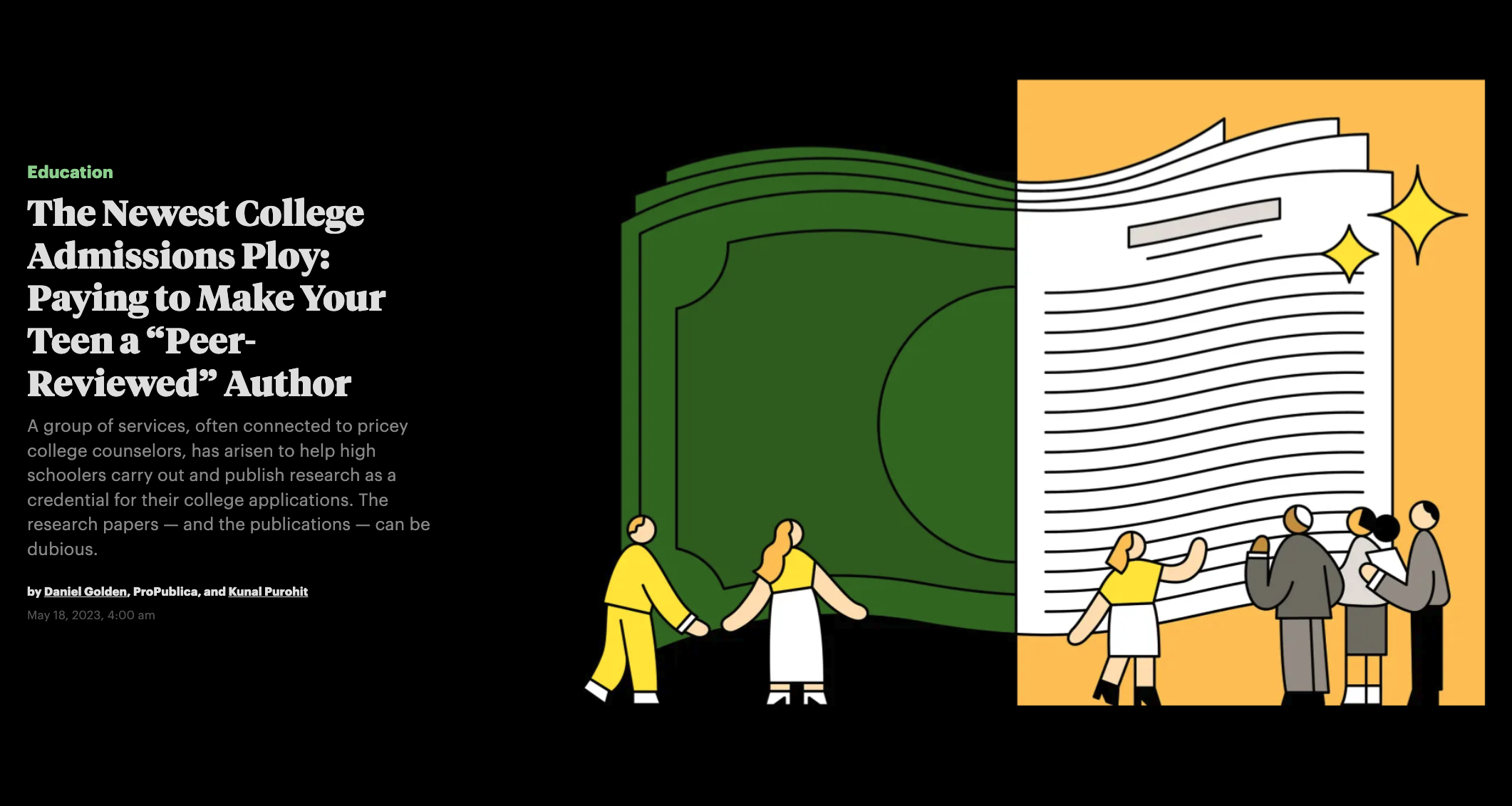
In May 2023, ProPublica documented what a lot of people in elite admissions already knew: a $79 million industry had emerged to manufacture the appearance of undergraduate research. Programs like Lumiere Education were processing 7,200+ students a year through Zoom calls with PhD candidates, steering their papers into journals accepting 65% of submissions — journals that exist, essentially, to house these papers. One anonymous Ivy League admissions officer called it a "fast-growing epidemic." Kent Anderson, former publishing director of the New England Journal of Medicine, delivered the real verdict: "You're teaching students to be cynical about research. That's the really corrosive part."
He's right. And the problem isn't just fraud. The problem is structural.
Here's what we named it: “manufactured certainty.”
A transaction that costs $6,000 and promises a publication cannot afford for the student to find nothing. So the outcome is engineered from the start. The research question is pre-designed to be answerable. The mentor's job is to produce a document, not guide inquiry. The uncertainty — the thing that makes research research — is the first casualty. What's left is credential theater. It looks like science. It performs curiosity. It is neither.
This isn't a bug in the pay-for-play model. It's the model.
And here's what manufactured certainty destroys that no publication can replace: the formation that comes from genuine encounter with an uncertain world. The student who walks out of real fieldwork with a disproven hypothesis and reconfigured assumptions has learned something that cannot be purchased. She's been changed. That's what we're calling Deep Research Formation — and it's defined by precisely the quality the credential industry cannot survive: productive precarity. The real possibility that you'll find nothing. That you were wrong. That you'll come back from the field changed in ways you didn't predict going in.
That risk is not a bug. It is the entire point.
KARSI has been running the opposite model for years.
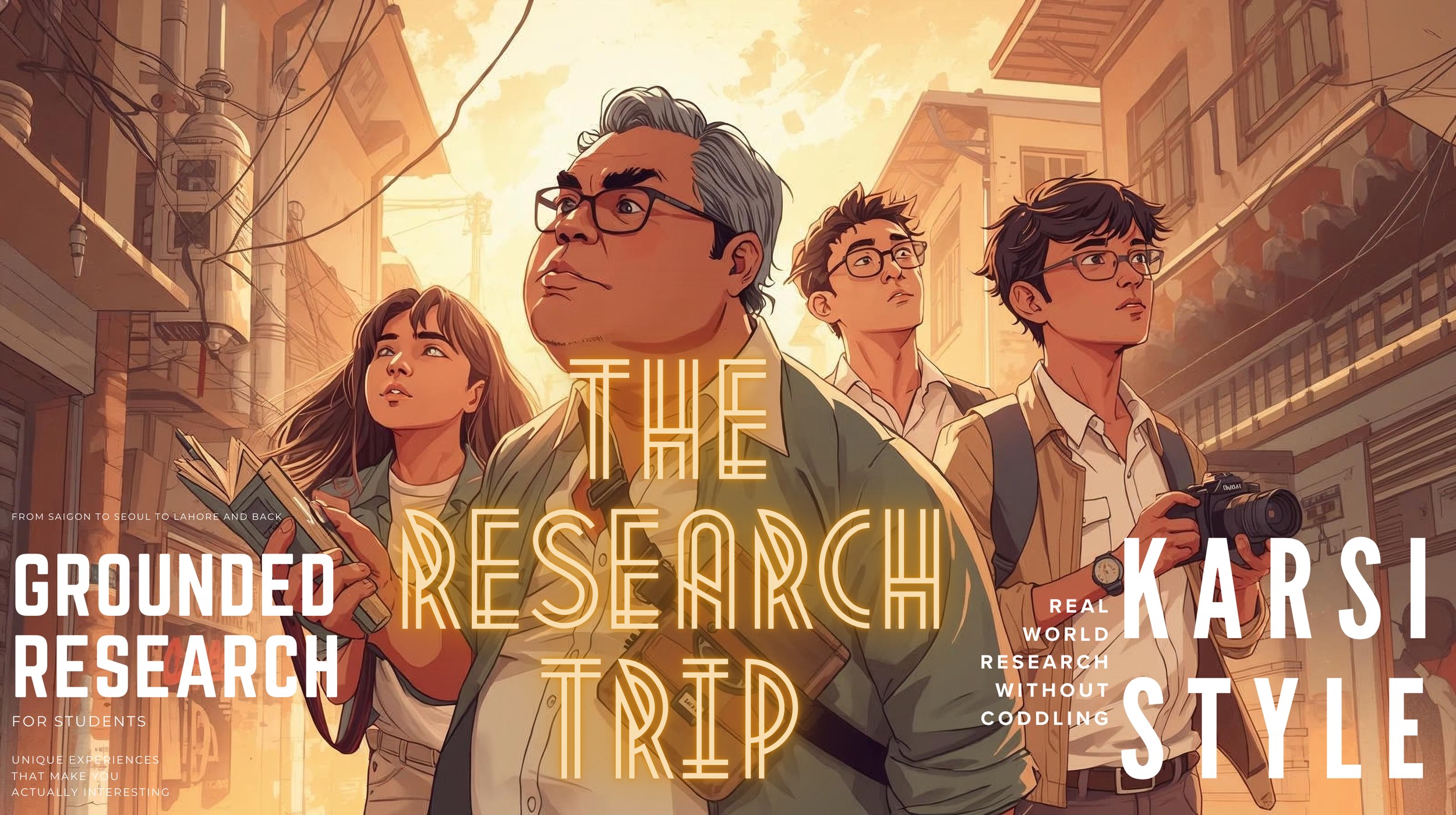
This is a much better movie to watch.
Vietnam. Yogyakarta. Australian interns through our Curtin University partnership, just finished. A Finnish intern through Salpaus last summer. Korean students doing real comparative fieldwork across Asia, with the Philippines coming up next. And now: taking students to major academic conferences — AAS-in-Asia — not just to sit in the audience, but to participate and extend active, ongoing research in the host country.
No Zoom. No guaranteed publications. No pre-designed research questions with pre-ordained answers.
Real research leaves room for discovery…and productive failure.
What KARSI offers instead is something the credential industry structurally cannot provide: a working research operation that students can actually join. When you go to Hanoi with KARSI, you're not completing a class assignment. You're generating primary data on Korean cultural flows that haven't been documented, hasn't been theorized, and represents genuine frontier territory in the field. When you go to a conference, you're not a tourist with a lanyard — you're extending active research with a professor who's publishing in the area.
And here's the part that doesn't appear in any pay-for-play brochure: students are expected to be wrong. Scaffolding failure is a core part of the methodology. Students come in with assumptions, hypotheses, framings they're confident about. The field doesn't care. Real social reality pushes back — it refuses to behave the way the literature said it would, the way the theory predicted, the way it seemed obvious it should. And students have to account for that. They have to look for other directions. They have to sit with not-knowing long enough to actually discover something. That is how knowledge gets made. That is what productive precarity actually feels like from the inside — and it's not comfortable, but it's the only process that produces genuine formation.
Which raises the question that nobody in the credential industry wants to answer: if a research program doesn't put students out in the field — in some actual contact with social reality — where they are genuinely testing hypotheses and being forced to build theories grounded in what they encounter, are they really doing research at all? And if they are in the field, but insulated from failure — if the outcome is guaranteed, if the hypothesis can't actually be wrong, if the mentor's job is to make sure the paper gets written regardless — then what exactly is being formed? Not a researcher. A student who has learned that research is a performance you execute, not a process you survive. That's not a credential worth having. That's the damage.
Nobody else in this space is doing this. Not because they haven't thought of it. Because it requires actual domain expertise, real institutional relationships across multiple countries, and an on-the-ground research operation built over two decades by a UC Berkeley PhD who has spent over twenty years doing this work in Seoul and across Asia. The cohorts are small — four to six students at a time. The smallness isn't a limitation. It's the methodology. Genuine mentorship cannot be scaled. Productive precarity cannot be industrialized. The things that make Deep Research Formation hard to replicate are exactly the things that make it work.
So why publish a white paper now?
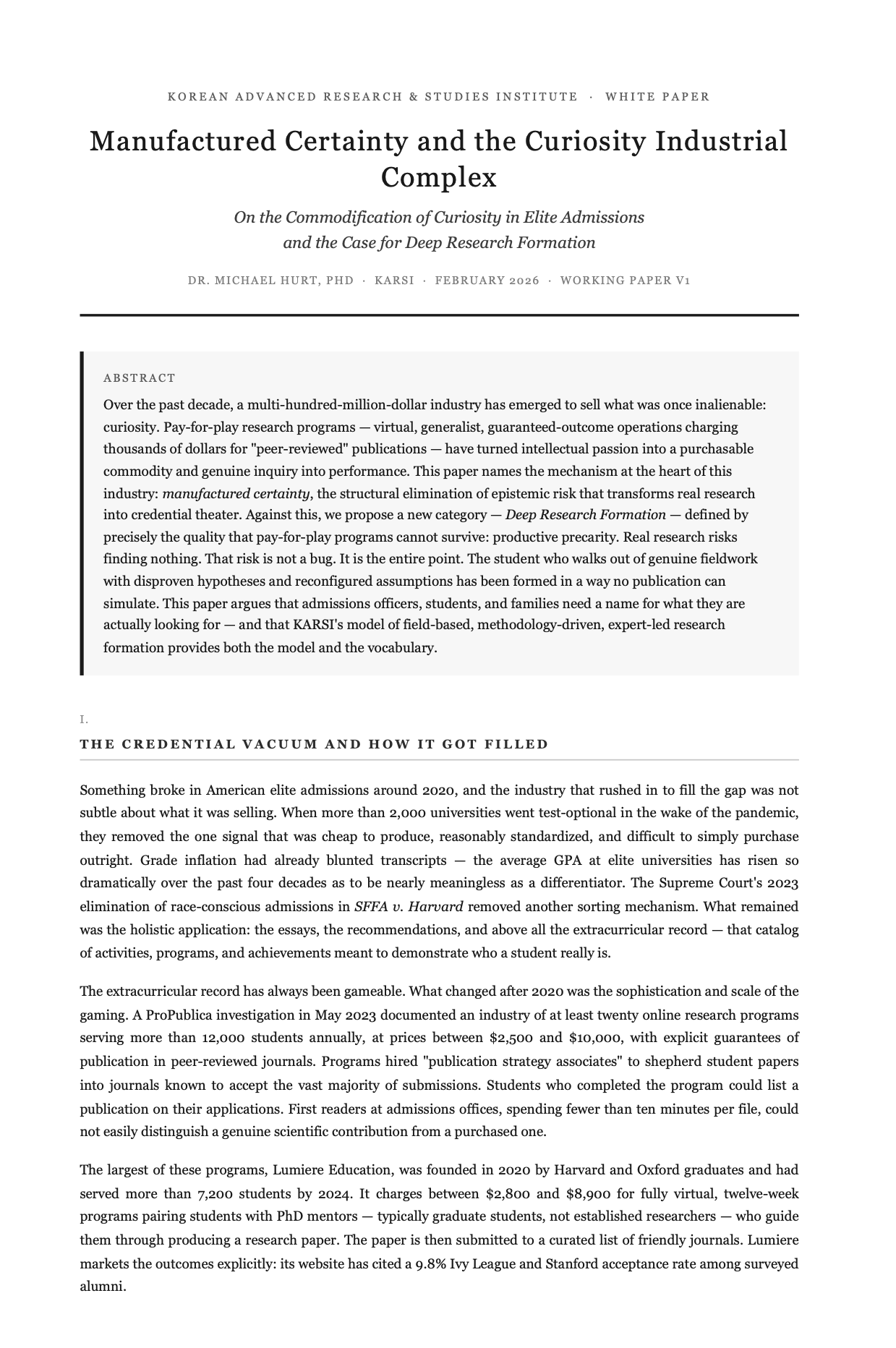
Download it in its entirety here.
Because the conversation needed new vocabulary. "Fake research" is a tabloid frame — accurate but too blunt to do real analytical work. What admissions officers, educators, and families actually need is a category distinction robust enough to function as a meaningful differentiator: a name that implies, in its structure, the difference between programs that transform students and programs that credential them.
"Manufactured certainty" names the mechanism. "Deep Research Formation" names the alternative. Together, they give you the conceptual tools to ask the right questions — of programs, of admissions offices, of your own assumptions about what research experience is actually supposed to do.
The Curiosity Industrial Complex sells certainty. What it cannot sell — and what no industrial process can manufacture — is the formation that comes from real encounter with an uncertain world.
That formation has always been the point. We just finally gave it a name.
[Read the full white paper here →]
If you're a journalist covering education, a parent navigating admissions, an educator who knows exactly what we're talking about, or an admissions officer who's been watching this unfold — we'd like to hear from you.
Contact: kuraeji@gmail.com
Dr. Michael Hurt is Founder and Director of KARSI (Korean Advanced Research & Studies Institute). He holds a PhD in Comparative Ethnic Studies from UC Berkeley and has conducted field-based cultural research across Korea, Vietnam, Indonesia, and Southeast Asia for over two decades. He teaches Modern Cultural Theory and Art History as aan djunct faculty member at the Korea National University of Arts.
AI Usage Statement: This post was drafted with assistance from Claude AI (Anthropic) for prose structure and editorial refinement. All theoretical framings, conceptual innovations, research insights, and intellectual positions are Dr. Hurt's own.