The Deliverables Delusion: The paper, the certificate, the award — and the interview question none of them can answer
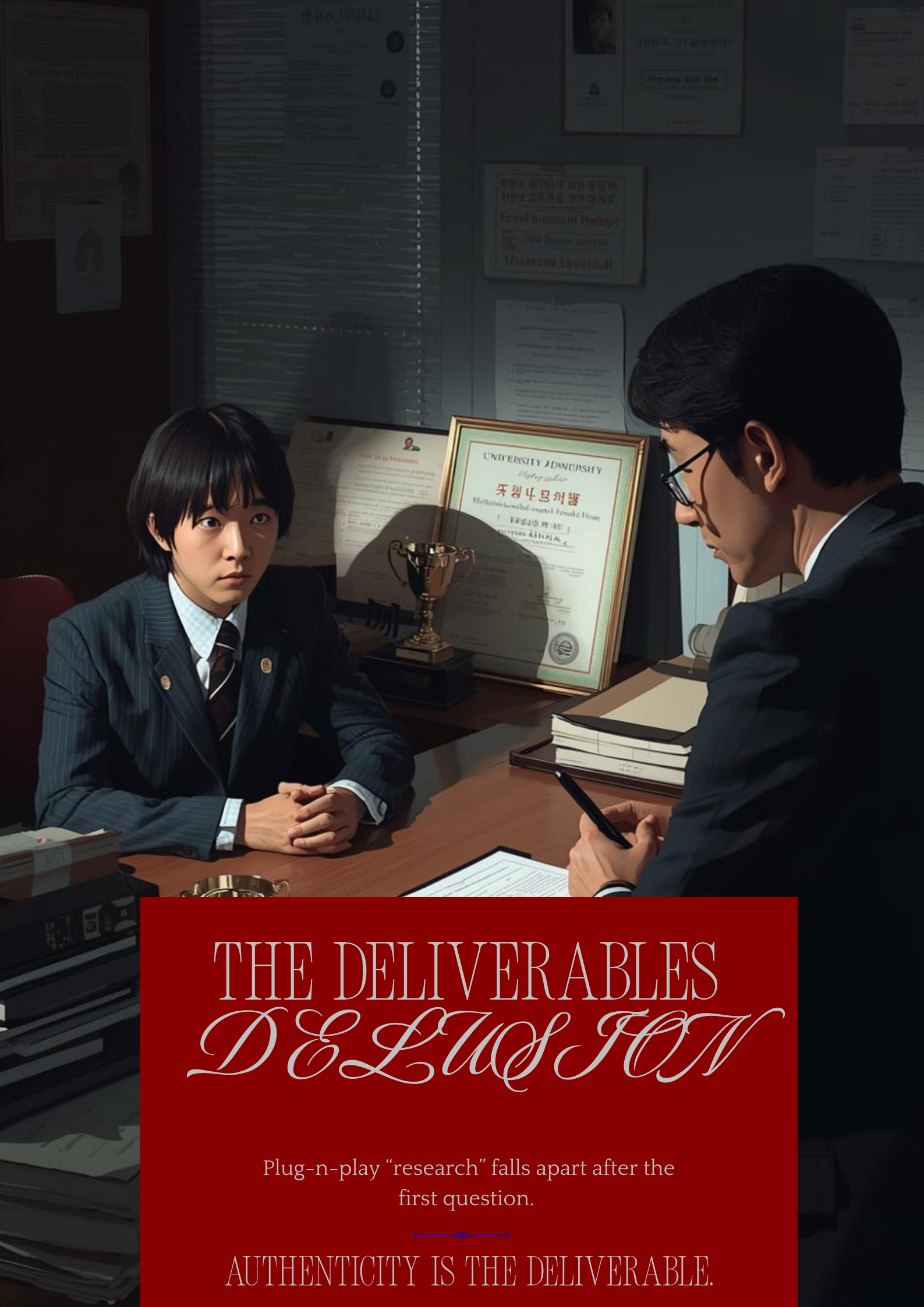
There is a question that every serious admissions interviewer eventually asks. It sounds like the easiest question in the room. It is actually the hardest.
So — why do you want to come here?
Not to a university in general. Not to "a school with strong academics and a vibrant community." To this school. With its specific intellectual culture, its particular way of doing things, the quality that makes it different from the sixteen other places you applied. The question is a simple invitation: show me that you are a real person with a real intellectual identity. Show me that you want something specific because you have become someone specific.
Most Gangnam-prepared students have no answer. Not because they aren't smart. Because nobody told them that answer was the entire point.
I know what that question sounds like from the other side of the table. I conducted alumni interviews for Brown University. I was the person asking it.
The Menu
Walk into almost any 유학원 in Gangnam and ask what they provide. They will show you a menu. Research papers. Journal publications. Nonprofit founding certificates. App portfolios. Competition awards. Each item is a concrete, pointable object — something that goes on a résumé line, something a parent can screenshot and send to the group chat. Something that looks like evidence of a student who does things.
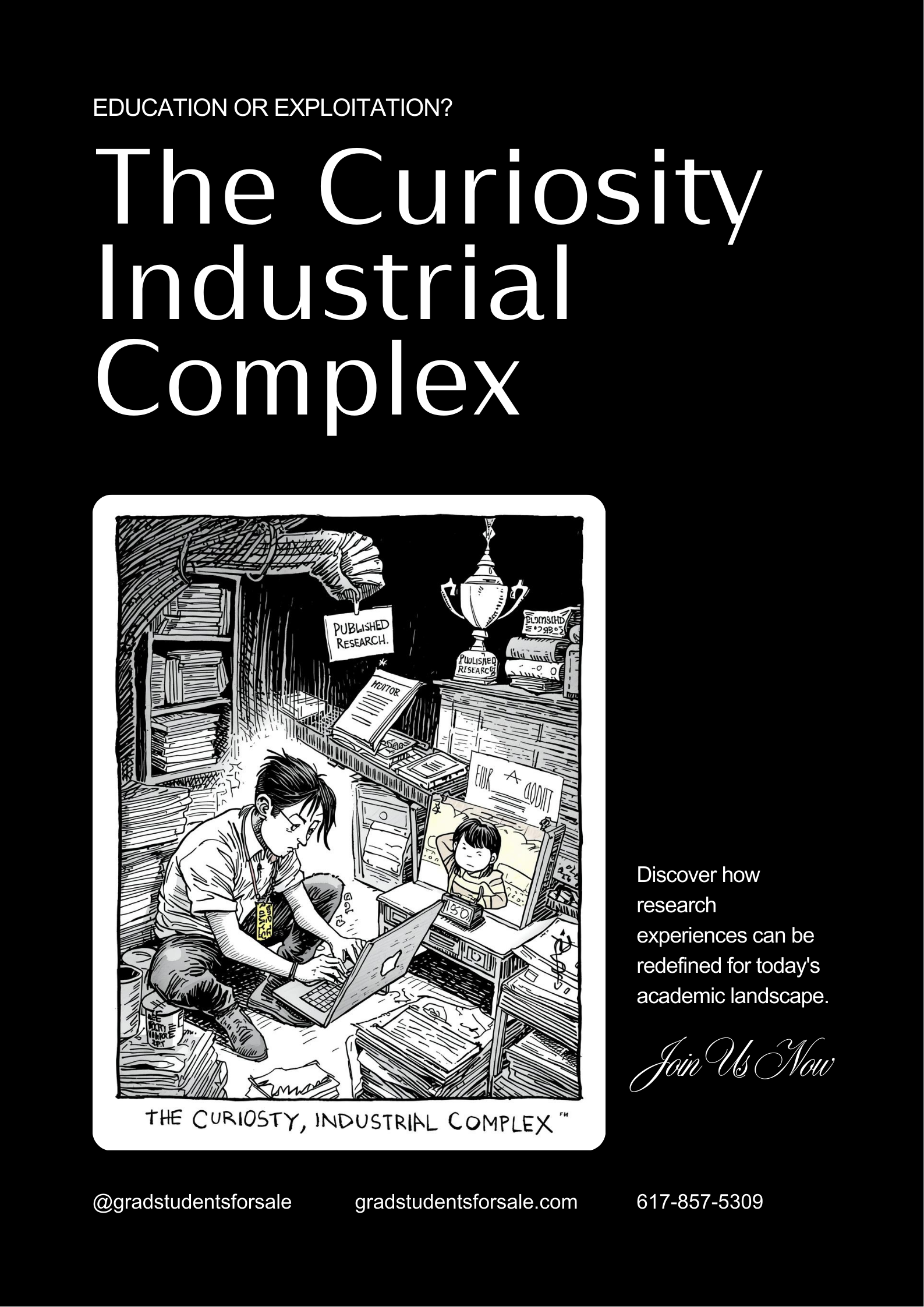
The industry has optimized ferociously for exactly this. The leading programs abroad have industrialized the process entirely — charging anywhere from $3,000 to $9,000 for virtual programs that walk students through pre-scaffolded research toward a guaranteed journal publication. The PhD mentor (typically a graduate student) guides the student to a predetermined positive result. The paper lands in a journal known for its acceptance rates. The line appears on the Common App. Delivered.
What has actually been delivered? A performance. An expensive, well-produced performance of intellectual curiosity — scripted, scaffolded, and staged for a first reader who has eight minutes to evaluate a file. The student didn't become curious. They performed curiosity. There's a significant difference, and increasingly, the people on the other side of the application know it.
Sara Harberson, former Associate Dean of Admissions at Penn, has said publicly that "passion project" has become a term with negative connotations among admissions readers. Not a selling point. A red flag. The credential the industry spent years building toward has become its own tell.
Bad Money, poor outcomes
There's an economic principle worth applying here. Gresham's Law: bad money drives out good. When counterfeit currency and real currency circulate together, people hoard the real and spend the fake until the real disappears from circulation entirely. The signal collapses.
This is exactly what has happened to the research publication as an admissions credential. When purchased publications become common enough — and they are now extremely common — the signal degrades completely. Elite admissions offices can no longer trust the line. So they've stopped trusting it. And they've started looking somewhere else.
Where they're looking is interviews.
Caltech now has students discuss their claimed research with an AI system, with faculty reviewing recordings to verify the student actually understands what they say they did. Duke has stopped scoring essays numerically. The entire direction of travel in elite admissions is toward verified, embodied, in-person demonstration of who you actually are. The essay was always gameable. The interview is not.
This is the shift the Gangnam deliverable economy is catastrophically unprepared for. The menu it has spent years perfecting is a menu for a restaurant that is closing.
What Actually Happens in the Room
The interview question isn't a trap. It's genuinely the simplest thing in the world: tell me about yourself in a way that's actually true. But a student who has spent three years accumulating deliverables — a student whose intellectual biography was designed by a consultant rather than lived by a human being — has almost nothing real to say.
They can recite the résumé. They can describe the project. They cannot explain why any of it mattered to them, because it didn't. The passion was performed, not felt. And in a room with an experienced interviewer, that gap opens up immediately. The first follow-up question — what surprised you about that research? what would you do differently? what did it make you want to know next? — and the whole scaffolding collapses.
This is not a hypothetical. I conducted Brown alumni interviews. I sat across from these students. The ones who lit up the room were not the ones with the longest résumé; they were the ones who couldn't stop talking about something they actually cared about. The difference was immediate, visceral, and completely unmistakable.
The student who did real fieldwork — who had a hypothesis disproven, who had to throw out their framework and rebuild it from scratch, who navigated a genuine research problem without a predetermined answer — that student can answer every follow-up question. Not because they practiced. Because the experience was real.
What I've Actually Seen Work
I want to be precise about something, because precision matters here.
I've had students work on genuine ethnographic research projects under my supervision — students who went on to get into Brown, NYU Tisch, and other highly selective programs. I cannot tell you with certainty that the work we did together was the reason. Admissions is not a controlled experiment. There is no counterfactual.
But here is what I can say: I cannot tell you it played no role, either.
What I gave those students wasn't a deliverable. It was a project that was actually theirs — research with real stakes, real methodology, real findings that surprised us both. More than that, I gave them a relationship to their own curiosity. A reason to care about something specific and serious. When they sat down to write their essays, they weren't performing passion. When they walked into an interview, they weren't reciting a script. They had something real to talk about, and it showed.
The projects that emerged from that process were legitimate. The passion that drove them was genuine. Whether a given admissions committee weighed it heavily or lightly, I have no way of knowing. What I know is that a student who has done real intellectual work carries it differently — in how they write, how they speak, how they present themselves under pressure. That quality is not nothing. In fact, at the most discerning institutions, it may be very nearly everything.
The honest version of what KARSI sells is this: we cannot guarantee admission anywhere. No one can, and anyone who tells you otherwise is lying to you. What we can do — what we have done — is make students genuinely more interesting. More formed. More capable of walking into a room and being exactly who they say they are.
That is not a minor thing. It is, increasingly, the only thing that holds up.
The Real Deliverable

What KARSI actually delivers, stated without decoration: a more interesting student.
Not a more credentialed student. A more interesting one. A student who has done real things in the world, who has encountered genuine intellectual difficulty and worked through it, who has a relationship to curiosity that was formed by actual experience rather than purchased from a program. That student is more competitive not because they have a stronger résumé line, but because they have become a more potent human being. Everything flows from that.
To be clear: real projects do sometimes produce real deliverables. A student who does genuine ethnographic research might end up with a paper. A student who spends weeks documenting a community might come out the other side with a short documentary film. A student who develops a genuine critical voice might publish an article. These things are not nothing — and unlike their purchased equivalents, they can withstand scrutiny because they emerged from actual work. We are not against deliverables. We are against deliverables as the goal.
Most consultants in Gangnam are doing it backwards. Their goal is the deliverable — the credential, the line item, the pointable thing — and they hope that somewhere in the process of chasing it, the student picks up some genuine formation along the way. Maybe they do. Often enough that the model persists. But it's backwards. The formation is the goal. The deliverable, if it appears at all, should be its honest byproduct — evidence of something real, not a substitute for it.
The admissions essay is already on its way to being a minor data point in a constellation of signals surrounding the applicant. The interview — or something very much like it — is where the weight is shifting. And in that room, the paper won't save them. The certificate won't save them. The award won't save them. What will save them — what will make them light up the room — is a genuine relationship to their own curiosity. The ability to talk about something they actually care about, follow a thought wherever it leads, and mean every word of it.
That is not a side effect of doing good work. It is the work. It is the only deliverable that matters when the door closes and the interview begins.
KARSI — Korean Advanced Research & Studies Institute — builds authentic, field-based research programs for high school students. Our most important deliverable is a more interesting human being. Everything else — the paper, the article, the film — follows from that.
AI Usage Statement
This article was written with significant assistance from Claude AI (Anthropic) in several specific capacities. The core arguments — the critique of the Gangnam deliverable economy, the analysis of the admissions interview as the emerging site of authenticity verification, the personal accounts of conducting Brown alumni interviews and working with students on genuine research projects, and the framing of KARSI's formation-first model as the correct inversion of industry standard practice — represent original human analysis, experience, and intellectual positions. AI assistance was utilized for: (1) structuring the argument in a Malcolm Gladwell-inspired narrative format with a counterintuitive hook and sustained conceptual throughline; (2) drafting and refining prose to match the KARSI editorial voice — accessible, direct, politically sharp; (3) integrating the Gresham's Law analogy and external references to admissions industry discourse; and (4) iterative revision across multiple drafts based on author direction and correction. All primary intellectual positions, the personal anecdotes, the institutional critique, and the underlying theory of student formation remain entirely the work of the human author, with AI serving as a writing and structural assistant.
This disclosure follows emerging standards for AI transparency in academic and online publishing. As institutions including Stanford University, MIT, and the University of California system have begun requiring explicit documentation of AI assistance in research and writing, such statements are becoming standard practice for maintaining scholarly integrity and reader transparency. Stanford's AI at Stanford Advisory Committee specifically emphasizes that "whenever somebody uses AI, even if the AI does some work, they need to take responsibility for the output" (Stanford Report, 2025). These usage statements represent part of broader efforts to establish ethical guidelines for AI integration in academic and journalistic work while preserving clear attribution of original human intellectual contributions.